
Terms and Conditions
Terms and Conditions
Last Updated: July 14, 2026
Welcome to www.tylerhayden.com (the "Website"), owned and operated by Tyler Hayden INC ("we," "us," or "our"). These Terms and Conditions ("Terms") govern your use of our Website, products, services, books, and courses, including those hosted on external learning management systems (such as Xperiencify or GoHighLevel).
By accessing our Website, registering for an account, purchasing our products, or booking a keynote engagement, you agree to comply with and be bound by these Terms. If you do not agree to these Terms, please do not use our Website or services.
1. Age Requirement and Eligibility
By using this Website, you represent that you are at least 18 years of age or the age of majority in your jurisdiction. If you are under the age of majority, you may only use this Website and purchase products under the direct supervision of a parent or legal guardian.
2. User Accounts and Security
To access certain features of our courses or programs (such as our LMS platforms), you may be required to register for a user account. You agree to:
- Provide accurate, current, and complete information during registration.
- Keep your password secure and confidential.
- Strict Prohibited Sharing: Your login credentials are for your individual use only. Sharing account access, course materials, or login credentials with other individuals is strictly prohibited and may result in immediate termination of your account without a refund.
3. Intellectual Property (IP) Rights
All content, designs, texts, graphics, logos, keynotes, team-building frameworks, exercises, book text, downloadable PDFs, software, and proprietary educational material available on this Website (including tools like Rubber Chicken AI and materials on Team Building School) are the exclusive intellectual property of Tyler Hayden INC or our licensors.
Except as expressly authorized by us, you agree NOT to:
- Copy, reproduce, redistribute, modify, or create derivative works from our materials.
- Sell, license, lease, or commercially exploit any of our products, tools, or course content.
- Use our content for training external audiences or commercial team-building services unless you have obtained an express, written commercial license from us.
4. E-Commerce, Payments, and Cancellations
- Billing and Payments: All fees are stated in the local currency indicated at checkout. Payments are processed securely via third-party processors (Stripe or PayPal). You authorize us to charge your chosen payment provider for any such purchases.
- Right to Cancel: We reserve the right to refuse or cancel any order at our sole discretion. This includes, but is not limited to, orders placed under clear pricing errors, inaccurate product descriptions, or transactions flagged by our systems as potentially fraudulent.
- Digital and Physical Refund Policy:
- Physical Products (e.g., printed books): If you receive a damaged or incorrect physical product, please contact us within 14 days of delivery for a replacement or refund.
- Digital Products and LMS Courses: Unless otherwise explicitly stated on the specific sales page, all sales of digital downloads, online courses, and software access are final.
5. Prohibited Activities
You agree not to use our Website or services to:
- Violate any local, national, or international laws or regulations.
- Spam, phish, or engage in any behavior that disrupts the technical integrity of our Website.
- Use automated scripts, spiders, or scrapers to extract data or content from the Website without our express permission.
- Decompile, reverse-engineer, or attempt to extract the source code of any proprietary tools, including Rubber Chicken AI.
6. General Disclaimers ("No Guarantees")
Our training, team-building exercises, books, motivational keynotes, and digital materials are provided for educational and informational purposes only. While our methodologies are designed to foster team learning, collaboration, and work-life balance, Tyler Hayden INC makes no guarantees regarding specific professional, organizational, financial, or team performance results. You accept full responsibility for your business outcomes when implementing any strategies discussed.
7. Limitation of Liability
To the maximum extent permitted by applicable law, Tyler Hayden INC, its officers, employees, and agents shall not be liable for any direct, indirect, incidental, special, consequential, or punitive damages resulting from your use of, or inability to use, this Website, its courses, or its tools.
In no event shall our total liability to you for all damages, losses, and causes of action exceed the amount paid by you, if any, for accessing our products or services during the twelve (12) months preceding the claim.
8. Governing Law and Disputes
These Terms, and any dispute arising out of or related to them, shall be governed by and construed in accordance with the laws of the **Province of Nova Scotia, Canada**, without regard to its conflict of law principles.
Any legal action, suit, or proceeding arising out of these Terms shall be instituted exclusively in the courts located in Halifax or the nearest applicable judicial district in Nova Scotia, Canada, and you consent to the personal jurisdiction of such courts.
9. Changes to These Terms
We reserve the right to modify these Terms at any time. Any changes will be posted on this page with an updated "Last Updated" date. Your continued use of the Website or our services after such modifications constitutes your acceptance of the updated Terms.
10. Contact Us
If you have any questions or require clarification on these Terms, please contact us at:
What we do.
We connect 100,000+ qualified prospects looking for financial advice, lending, protection, debt help and claims to advisors and brokers every year.
It's all about the numbers.
As a performance marketing agency driven by data, our comprehensive approach ensures promoting successful results, consistently aiming for a positive return on your advertising expenditure.
500+
Project Delivered
$60M+
In Partner Revenue
10,346
Positive Reviews
What We Do
Your proven customer acquisition system that increases conversion rates at every step of the customer journey so you can enjoy record breaking sales.
Effective Lead Generation
Strategically focused on high-intent leads generation tactics from Google, Bing, & YouTube.
Database Reactivation
Turn your old data into fresh appointments and sales, utilising our sales android that never rests.
Appointment Setting
Transform your contact rate and campaign profitability with our appointment setting sales android.
For customers.
Can I Cancel At Any Time?
Yes. You can cancel your paid subscription at any moment by visiting the billing section of your account.
Does NexLevel integrate with other platforms?
Yes. The NexLevel dashboard integrates with almost every platform. Many business owners integrate NexLevel with their existing CRMs so they can see their sales cycle more accurately. The majority eventually replace their entire CRMs and use only NexLevel to manage their entire business, usually at a cost of one-third.
Will my subscription automatically renew?
Yes, a monthly renewal of your subscription is automatic. You are always free to cancel.
Is working on NexLevel easy?
Absolutely! NexLevel can be active in less than an hour. We will direct you to the instructional videos that will show you exactly how to receive your leads as soon as you enter the member's area. You don't need a tech team! However, if you'd prefer to have this all done for you, we do have one accessible.
What if my business has several locations?
If you have multiple locations, you will need one account per location. If so, get in touch with us, and we'll give you a pricing per location.
What kind of assistance do you offer?
You can continue communicate with us easily after first setup! Jump on Zoom calls, live chat, or just email conversations with the team. We promise that you have never experienced customer service like this!
If the answer to your question is not on this page, please contact our experts.
For partners.
Lorem ipsum dolor sit amet, consect adipiscing elit, sed do eiusmod tempor incididunt.
Can I Cancel At Any Time?
Yes. You can cancel your paid subscription at any moment by visiting the billing section of your account.
Does NexLevel integrate with other platforms?
Yes. The NexLevel dashboard integrates with almost every platform. Many business owners integrate NexLevel with their existing CRMs so they can see their sales cycle more accurately. The majority eventually replace their entire CRMs and use only NexLevel to manage their entire business, usually at a cost of one-third.
Will my subscription automatically renew?
Yes, a monthly renewal of your subscription is automatic. You are always free to cancel.
Is working on NexLevel easy?
Absolutely! NexLevel can be active in less than an hour. We will direct you to the instructional videos that will show you exactly how to receive your leads as soon as you enter the member's area. You don't need a tech team! However, if you'd prefer to have this all done for you, we do have one accessible.
What if my business has several locations?
If you have multiple locations, you will need one account per location. If so, get in touch with us, and we'll give you a pricing per location.
What kind of assistance do you offer?
You can continue communicate with us easily after first setup! Jump on Zoom calls, live chat, or just email conversations with the team. We promise that you have never experienced customer service like this!
If the answer to your question is not on this page, please contact our experts.
We will always provide the best service.
We're not in the business of launching rockets. Our specialty lies in cultivating leads from Google, Bing, and YouTube, then seamlessly channeling them to your team instantly. And frankly, we excel at it.
Benefit from leads generated by our already mature campaigns.
Allow us to create custom lead generation campaigns tailored to your brand.
Enhance contact rates with the deployment of our AI sales androids.
Take advantage of our tested systems and technology to maximize your return on advertising spend.

Does a lead generation Include.
Lorem ipsum dolor sit amet, consect adipiscing elit, sed do eiusmod tempor incididunt ut labore mag aliqua sehi fociras ad some sample text here.
Colors
Strategically focused on high-intent leads generation tactics from Google, Bing, & YouTube.
Design
Turn your old data into fresh appointments and sales, utilising our sales android that never rests.
Typography
Transform your contact rate and campaign profitability with our appointment setting sales android.
Our effective lead generation process.
Lorem ipsum dolor sit amet, consect adipiscing elit, sed do eiusmod tempor incididunt ut labore mag aliqua sehi fociras.
Discovery
Revisions
Research & Brand Srategy
Presentation
Sketching
Delivery & Support
Want to get in touch?
Frequently asked questions.
If the answer to your question is not on this page, please contact our experts.
Can I Cancel At Any Time?
Yes. You can cancel your paid subscription at any moment by visiting the billing section of your account.
Does NexLevel integrate with other platforms?
Yes. The NexLevel dashboard integrates with almost every platform. Many business owners integrate NexLevel with their existing CRMs so they can see their sales cycle more accurately. The majority eventually replace their entire CRMs and use only NexLevel to manage their entire business, usually at a cost of one-third.
Will my subscription automatically renew?
Yes, a monthly renewal of your subscription is automatic. You are always free to cancel.
Is working on NexLevel easy?
Absolutely! NexLevel can be active in less than an hour. We will direct you to the instructional videos that will show you exactly how to receive your leads as soon as you enter the member's area. You don't need a tech team! However, if you'd prefer to have this all done for you, we do have one accessible.
What if my business has several locations?
If you have multiple locations, you will need one account per location. If so, get in touch with us, and we'll give you a pricing per location.
What kind of assistance do you offer?
You can continue communicate with us easily after first setup! Jump on Zoom calls, live chat, or just email conversations with the team. We promise that you have never experienced customer service like this!
Costumer review.
See why customers love GHL Elite.

"If you're looking for an all-in-one app to help you increase sales and save time on follow-ups, I would highly recommend NexLevel CRM."
– Rachel Johnson


"Our team has been using NexLevel for a few months and we are very happy with the results. We've closed more deals than ever before and our sales team loves it."
– Mike Nord

"You never know what you're missing until you try NexLevel. We've been using it for 9 months and it has helped us double our pipeline and close more deals."
– Heather Mathewson

"Since using NexLevel over a year ago, I’ve generated $300k+ in new revenue and saved more than 20 hours per week on administrative tasks like reminders and reschedules."
– Ranjana Muthaliar





Blog
Your proven customer acquisition system that increases conversion rates at every step of the customer journey so you can enjoy record breaking sales.
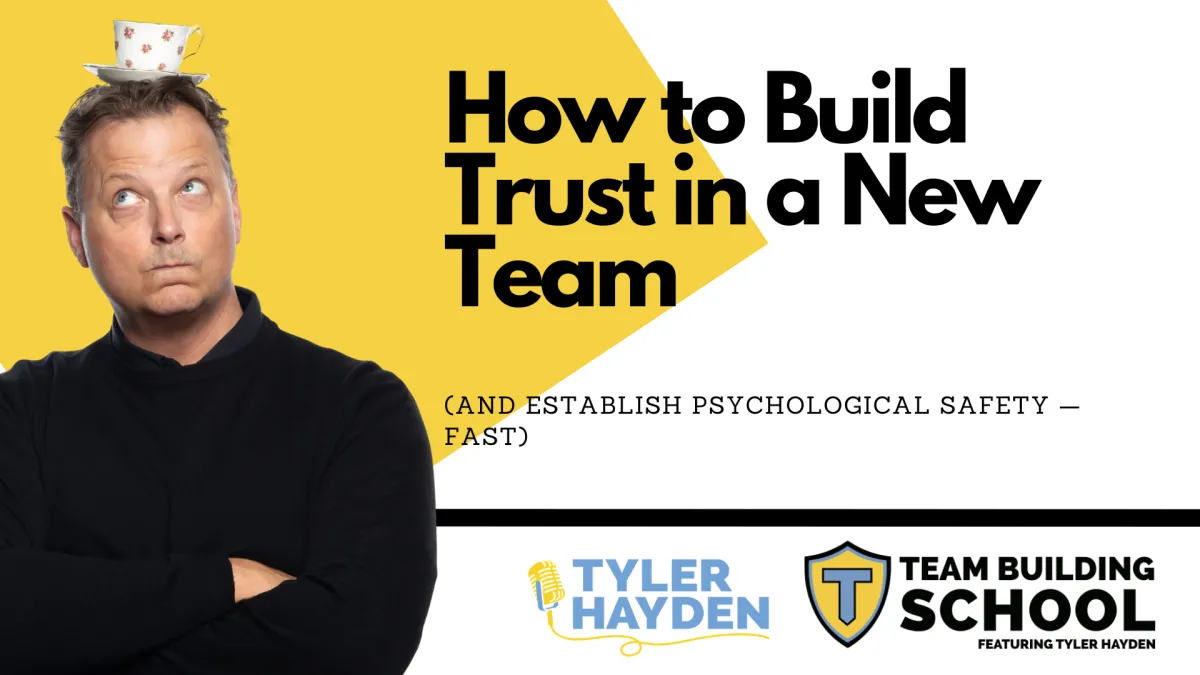
How to build trust in a new team and establish psychological safety fast (And Establish Psychological Safety — Fast)
How to Build Trust in a New Team (And Establish Psychological Safety — Fast)
By Tyler Hayden CSP, HoF — Hall of Fame Motivational Speaker & Organizational Development Expert
Psychological safety is one of the most talked-about concepts in modern leadership — and one of the least understood in practice.
Most leaders know they’re supposed to create it. Far fewer know what it actually looks like when it’s missing, what it feels like when it’s present, or how to build it deliberately and quickly when the clock is ticking and the stakes are real.
This post is for those leaders. The ones stepping into a new team, a skeptical room, or a group that’s been burned before — and who need more than theory.
Here’s what 30 years in the room actually looks like.
What the Absence of Trust Looks Like
Before you can build trust, you have to be able to read its absence — and it shows up long before anyone says a word.
Walk into a low-trust room and you’ll notice it immediately:closed arms. Eyes that drift away instead of making contact. A quiet that feels heavy rather than peaceful.Questions go unanswered. Hands don’t go up. Participation is pulled out rather than offered.
These are the non-verbals of a group that is in protection mode. They’ve either been let down before, they don’t yet feel safe with the people in the room, or the culture they work in has taught them that visible engagement carries risk.
You can feel it. And once you know what you’re looking for, you can’t unsee it.
That awareness — reading the room before you open your mouth — is the first skill of anyone serious about building psychological safety.
The Most Important Five Minutes You’ll Ever Plan
Here’s something most facilitators and leaders get exactly backward: they spend the most time planning the main event and almost no time planning the opening.
I do the opposite.
My first five minutes are the most planned, most intentional part of every session I run.Because those five minutes set the entire trajectory of what follows. Get them right, and the rest of the time becomes dramatically easier. Get them wrong, and you spend the next hour trying to recover ground you never had to lose.
Before I walk into any room with a new team, I do my homework:
·What are their job functions?
·What are their learning preferences?
·What have their previous team experiences looked like?
·What wounds might they be carrying in?
That information shapes everything about how I open. The tone I use. The activity I start with. The expectations I set. The level of vulnerability I ask for — which in minute one, is almost zero.
The goal of the first five minutes isn’t to build trust. It’s to create the conditions where trustcanbe built. That’s a different, more achievable goal — and a much better place to start.
What Psychological Safety Actually Feels Like
When a group has psychological safety, you see it in one specific thing:they lean in.
They take risks. They contribute ideas before they’re sure those ideas are good. They try new activities without knowing if they’ll look competent. They’re okay flirting with failure. They don’t need to maintain perfect composure because they know the room won’t punish them for being human.
It’s a judgment-free zone — and everyone in the room can feel it.
When a groupdoesn’thave it, theylean away.Requests for input are met with hesitation. Sharing an idea feels like exposure. The invisible threat of reprisal — social, professional, or otherwise — keeps people in their seats, arms crossed, waiting for it to be over.
What makes this more complicated is that most of what people bring into the room is invisible to you. Past experiences with bad managers. A corporate culture that punishes mistakes. A previous facilitator who pushed too hard, too fast, and scraped open wounds that weren’t ready to be touched.
People walk into your session in bare feet, surrounded by mousetraps you can’t see. The more you know about your people — through consistent culture-building, get-to-know-you activities, and genuine relationship investment — the better equipped you are to guide them safely through.
A Story: The Group That Almost Didn’t Come
I was brought in to work with a group that supports the military. They were dealing with the fallout of genuinely bad leadership — and the new leadership wanted to give the team a positive, uplifting day to explore who they were and what they could offer each other and the organization.
The problem: some people didn’t want to come.
And with good reason. Their previous leader had hired a facilitator who pushed the group to open up about painful things — far too early in their development, with no trust foundation in place, and no sensitivity to what they were ready for. That facilitator left wounds. The new team was now walking into a room pre-loaded with dread.
So before I designed a single activity, I focused on one thing:the learning progression.
I took extra time selecting activities that built deliberately on top of one another — starting with the lowest-possible-stakes interactions, stacking small wins, building energy incrementally. Low-hanging fruit first. Genuine laughs before genuine vulnerability. Trust before depth.
By the end of the day, people who had walked in ready to leave described the experience as transformative.
Nothing magical happened. No breakthrough exercise. No single moment of revelation. Just a carefully sequenced progression that met people exactly where they were and moved them, gently and consistently, toward somewhere better.
That’s what psychological safety looks like when it’s built right.
The Trust Bank Account
Let me give you the most important mental model for understanding psychological safety over time.
Think of trust like a bank account.
Every positive interaction — every moment of genuine recognition, every meeting that respects people’s time, every conflict navigated well, every leader who does what they said they’d do — is a deposit. Small deposits, made consistently, over time.
The account grows quietly, in the background, during the good times when nobody thinks they need it.
And then something breaks. A difficult decision. A leadership change. A conflict that gets out of hand. A mistake that costs the team something real.
That’s when you make the withdrawal.
If the account is full, the team weathers it. They’ve got reserves of trust built up from months of genuine investment. They extend grace because they’ve seen you earn it.
If the account is empty — if you’ve been making withdrawals without deposits, or simply never investing at all — there’s nothing to draw from. And rebuilding from zero is a much harder, longer process than simply never letting it run dry.
This is why team building and culture investment can’t be a once-a-year retreat. It has to be continuous, incremental, and intentional. You don’t know when you’ll need the reserves. You just know you will.
The Repeatable Framework: Three Steps to Safety
Over the years, I’ve distilled my approach to establishing psychological safety quickly into three steps that work regardless of industry, team size, or how skeptical the room is going in.
Step 1: Set the StageIn those first five minutes, establish the rules of engagement. Name the culture you’re building right now, in this room. Set behavioral expectations clearly. Tell people what this space is — and what it isn’t. Make the container explicit so people know what they’re stepping into.
Step 2: Invite ParticipationKeep the doors open. Ask, don’t tell. Share wins early and often. Design every early interaction so that saying yes is easy and low-risk. The goal is to create as many small moments of willing participation as possible — each one a micro-deposit of trust.
Step 3: Respond AppropriatelyThis is where most facilitators and leaders fall short. When someone takes a risk and participates,how you responddetermines whether others will follow. High fives, genuine encouragement, and visible appreciation signal that it’s safe to try. Equally important: gently and consistently managing strong personalities or fear-inducing behaviors that would shut others down.
Safety is both created and protected. You build it with encouragement, and you guard it with appropriate boundaries.
What Destroys Safety — Instantly
The fastest way to shatter psychological safety is to make someone feel unseen, excluded, or judged for who they are.
This happens most acutely aroundinclusion— moments where a comment, a joke, an assumption, or an action contradicts a person’s deeply held sense of identity or worth. You may not intend it. You may not even realize it happened. But the person it landed on felt it immediately — and so did everyone else watching.
The challenge is that you often can’t know where these landmines are just by looking at someone. Their history, their identity, their fears — they’re invisible until something detonates them.
This is precisely why consistent, ongoing culture-building isn’t optional.The more you invest in getting to know your people — through regular team tools, icebreakers, and connection activities — the more data you have to work with. You learn the bare feet. You learn where the mousetraps are. And you learn how to guide people safely past them.
Tools like Rubber Chicken AI at rubberchicken.ai exist for exactly this reason — to help managers plan their trust-building moves ahead of time, the same way you’d plan a content calendar or a strategic plan. Reward and recognition ideas, engaging meeting agendas, non-cringy icebreakers — all mapped to your team’s specific makeup and objectives, so you’re never scrambling and never guessing.
How Long Does It Actually Take?
Here’s the honest answer:there is no finish line.
Psychological safety is not a destination. It’s a journey — and it’s one that requires continuous investment, because trust is both builtandbroken over time.
A leader who builds incredible safety this quarter can lose significant ground next quarter through a single poorly handled conflict, a broken promise, or a moment of public humiliation that should have been a private conversation.
The account is always live. You’re always either making deposits or making withdrawals, whether you intend to or not.
The leaders who build the most resilient teams aren’t the ones who had one great retreat. They’re the ones who showed up, week after week, making small, consistent investments that compounded into something the team could actually lean on when things got hard.
Stepping Into a Team That’s Been Burned
If you’re walking into a team with a history of trauma — a toxic predecessor, broken promises, a facilitator who pushed too hard — there’s one quality that matters above all else:
Empathy.
Put yourself in their shoes. Approach the situation the way you’d want someone to approach it ifyouwere the one sitting in that chair, carrying that history, trying to decide whether to trust again.
Be the behaviors the room needs in order to feel safe. Not the behaviors you’re comfortable with — the onestheyneed.
And know this: your role isn’t fixed. Some moments call for the judge — clear boundaries, firm expectations, a steady hand. Other moments call for the counsellor — warmth, patience, a willingness to sit with discomfort rather than rush past it.
The best leaders read the moment and adjust. They don’t have one mode. They have range.
And that range — that ability to meet people exactly where they are — is ultimately what psychological safety is built on. Not exercises. Not frameworks. Not retreats.
A leader who genuinely sees their people, and shows up for them differently depending on what they need.
Monday Morning Moves
·✅Read the room before you open your mouth— non-verbals tell you everything
·✅Plan your first five minutes more than anything else— it sets the whole trajectory
·✅Start with low-hanging fruit— small wins before big asks, always
·✅Build the trust bank account consistently— deposits during good times, withdrawals during hard ones
·✅Use the three-step framework:Set the stage → Invite participation → Respond appropriately
·✅Know your people— the more data you have, the fewer mousetraps you’ll trigger
·✅Adjust your role— judge when the room needs structure, counsellor when it needs warmth
·✅Treat safety as a journey— it never gets checked off the list
Fun is the delivery. Better teams and energy on Monday is the point.
For tools that help you plan consistent, intentional trust-building across your team — from recognition programs to non-cringy icebreakers — exploreRubber Chicken AIandTeam Building School.
Tyler Hayden CSP, HoF is Canada’s Hall of Fame Motivational Speaker, author of 25+ books, and founder of Team Building School and Rubber Chicken AI. He has spent 30 years helping organizations

Follow Us & Join the Conversation


Locations Served
Shop, Learn, and Explore
Speaker Topics
Location and Contact
(902) 541-0858
23 Horizon Road
Bedford, Nova Scotia B4A 3N2
Canada
© 2026 Tyler Hayden Inc. All rights reserved.