
The Team Swell Methodology: Structuring the Lifecycle of High-Performing Team Framework
Formulated by Hall of Fame speaker Tyler Hayden, "The Team Swell" is an operational blueprint mapping the exact behavioral science of a high-functioning team hitting its absolute peak. From the moment your team walks through the door to the final project debrief, The Team Swell methodology decodes the specific leadership interventions required across a project’s lifecycle to sustain long-term engagement.
Core Deliverables: 1. The BME Lifecycle Framework 2. Push vs. Pull Leadership Matrix 3. Time & Energy Optimization Strategies.
Section 1: The Core Philosophy — What is The Team Swell?
Axiom: "A great team doesn't just happen; it is actively engineered through a beginning, middle, and an end."
Think back to a time when you had a high-functioning team that really knocked a project or venture out of the park. That momentum isn't accidental. It requires a leader who understands how to invest and plan for specific developmental stages.
The Team Swell methodology matters specifically for managers who want to:
🔥 Increase strategic engagement over long-term projects.
🔥Explore planning for sustained team production.
🔥Invest in levelling-up their dynamic leadership skills.
🔥Focus on building a deeply connected, strong team culture.
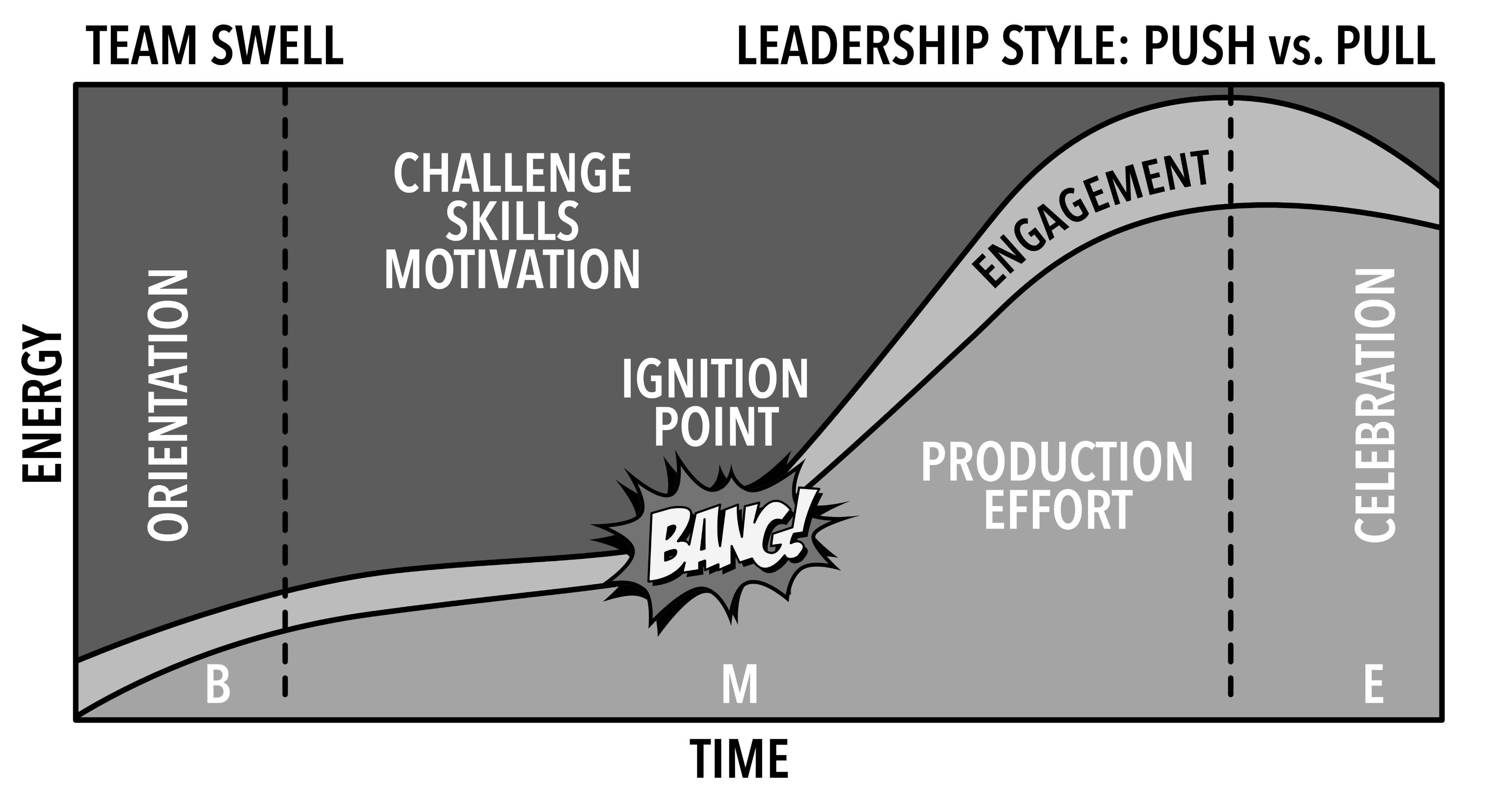
Section 2: The BME Lifecycle (Beginning, Middle, and End)
Every team project has a beginning, middle, and end phase (BME). Long-term operations should have micro-BME cycles built throughout their lifespan (quarterly, annually, etc.).
1. Beginning (The Orientation Stage)
The Profile: In this stage, production output is very low—it is strictly the planning and organizing phase. Done correctly, this is where the engagement foundation is laid.
Core Leadership Actions:
🔥Get to know basic information (names, roles, specific skills, and strengths).
🔥Establish the purpose of the team, how work will be measured, and share the overarching strategy.
🔥Set the clear timeline and expectations for the team's time together.
🔥Audit the resources and context in relation to what people need to get the job done.
2. Middle (The Active Work Phase)
The Profile: This is the reason the team exists. Through appropriate injections of challenge, skill allocation, and motivation tools, engagement elevates and production amplifies.
The Three Drivers of the Middle Phase:
🔥 Ignition: The tipping point when it all comes together, and output dramatically trends upward.
🔥 Production: The measurable work your team is tasked to complete because they are properly skilled and highly motivated.
🔥 Engagement: The experiential feeling of the team functioning together, sharing energy, and taking immense pride in the work done.
3. End (The Celebration Phase)
The Profile: The most critical, yet frequently overlooked stage. This provides the psychological closure that human beings crave.
Core Leadership Actions:
🔥 Recognize achievements and efforts with a logical "close" or "exit" from the project phase.
🔥 Leverage organizational success as a springboard into the "next phase" or future onboarding.
🔥 Create a touchstone of positive memories and feelings to ensure long-term talent retention.
Section 3: Push vs. Pull Leadership Tactics
Depending on the developmental stage of your team within the BME lifecycle, a savvy manager must purposefully utilize either a Push or Pull leadership strategy to get the best out of their people.
The Push Strategy (Task-Centred Approach)
Behavioural Profile: Exerting clear direction using strong motivational tactics, heightened challenges, and specific instructions to elicit a sense of urgency.
Strategic Timing: Critical to use at the Beginning of the team's time together, or during times of project crisis.
The Pull Strategy (Goal-Centred Approach)
Behavioural Profile: Sharing the locus of control with a positively functioning team. Involves inquiry, guided facilitation, and leading from an agreed-upon approach.
Strategic Timing: Highly effective in the Middle stages to encourage autonomy and a team-centred approach to decision making and effort.
Section 4: The Engines of Engagement — Time and Energy
The two most critical variables of team engagement are Time and Energy. Too often, leaders discount the function of time and its direct correlation to team energy.
Time (The Forgotten Key)
Time enables authentic engagement. If a project drags too long, the team loses focus; if the timeline is too short, the team fractures under stress. An engaged team thrives on a timeline built for connection, collaboration, eustress (positive challenge), celebration, and visioning.
Energy (The Leadership Maestro)
A great manager serves as the maestro of their team’s energy. By carefully calculating when to add tasks, when to inject challenges, and when to apply motivation, the leader inspires the team to generate and share their own energy. As collective energy increases, production and engagement universally amplify.
Written by Tyler Hayden | [email protected]. Repurposing info requires review; must attribute and backlink to tylerhayden.com and teambuildingschool.com.
What we do.
We connect 100,000+ qualified prospects looking for financial advice, lending, protection, debt help and claims to advisors and brokers every year.
We will always provide the best service.
We don't launch rockets. We just generate leads from Google, Bing and YouTube, connecting them with your team in real time. And you know what, we're bloody good at it.
Get leads from our existing matured campaigns.
Let us build bespoke lead-gen campaigns in your brand.
Deploy our AI sales androids to boost contact rate.
Utilise our proven systems and technology to increase your return on ad spend.

What We Do
Your proven customer acquisition system that increases conversion rates at every step of the customer journey so you can enjoy record breaking sales.
Effective Lead Generation
Strategically focused on high-intent leads generation tactics from Google, Bing, & YouTube.
Database Reactivation
Turn your old data into fresh appointments and sales, utilising our sales android that never rests.
Appointment Setting
Transform your contact rate and campaign profitability with our appointment setting sales android.
Blog
Your proven customer acquisition system that increases conversion rates at every step of the customer journey so you can enjoy record breaking sales.

5 Surprising Ways Workplace Culture Impacts Mental Health and Job Satisfaction
5 ways to improve mental health & job satisfaction by motivational speaker Tyler Hayden. Research based actions lead the way to better engagement.
In today’s fast-paced corporate landscape, understanding the intricate dynamics of workplace culture is crucial for improving both mental health and job satisfaction. While many organizations focus on profits and productivity, the underlying culture plays a pivotal role in determining employee well-being and engagement. Here, we will uncover five unexpected ways workplace culture affects mental health and job satisfaction, with actionable insights and data-driven strategies to foster a healthy and motivating work environment.
The Role of Team Building in Mental Health
Imagine a workplace where Monday mornings aren’t greeted with groans but rather with excitement and anticipation. Take off your rose coloured glasses, right? Not so much, this is where the magic of team building comes in – a sometimes underrated but highly effective tool for enhancing workplace culture and mental health. While corporate team activities are intentional in optimizing collaboration, they inadvertently serve as a balm for mental distress. According to a study conducted by the American Psychological Association employees engaging in regular team building activities reported lower stress levels and increased job satisfaction. Not to mention the amazing outcomes it has at reducing loneliness!
Team bonding exercises, when done right, foster a sturdy web of social support that acts as a lifeline during challenging times. The ability to foster team spirit during a seemingly simple task like a team-oriented morning huddle can translate into a greater sense of belonging. Who knew using a structured morning check in could lead to such real-world benefits like strengthening work relationships and workplace synergy?
“Social capital and mental health go hand in hand. The connections we form at work are often as important as those we form outside of it.” – Organizational Psychology Expert.
Moreover, beyond just cracking tough puzzles or navigating ‘trust falls’ (ask us how www.teambuildingschool.com), strategic business focused team building initiatives can help mitigate burnout. When employees feel connected to their colleagues, they're more likely to support each other, which lessens the burden of stress and fosters a culture of empathy and understanding.
For leaders, incorporating employee engagement strategies focused on team development is not just beneficial for the workforce but also a strategic move towards achieving a positive work environment. After all, a happy team is a productive team. By providing avenues for professional development workshops and goal-oriented team activities, companies can transform their workplace culture from the ground up. This helps building strong teams and inspire office morale improvement.
Action: Commonalities
This is a simple activity that will help to generate team engagement through common connections. These common connections is just one of the positive team collaboration techniques that team building can help to inspire. If you'd like to learn more about it try a our Free Course at Team Building School and get a FREE Team Building Tool: Commonalities.
Fostering a Positive Work Environment Through Motivation and Inspiration
A thriving workplace culture has the power to act as a life line to struggling employees, boosting mental health and satisfaction through the healing properties of motivation and inspiration. Have you ever witnessed how a single motivational keynote can breathe life into a room? A professional motivational seminar can help at fostering teamwork spirit, boost workplace morale, and enhance team cohesion. According to a study by Gallup, companies that incorporate motivational sessions into their routine see an impressive 21% uplift in productivity and employee engagement—a statistic that speaks volumes about the value motivation in the workplace (source).
These sessions, often led by seasoned motivational speakers, pour a fresh perspective and renewed sense of purpose into the workspace. It's akin to rebooting a computer that’s been running sluggishly for far too long—suddenly, everything functions smoother and faster! Beyond anecdotes, there’s evidence that these initiatives:
Elevate office morale
Foster a spirit of inclusivity and belonging
Enhance communication and collaboration skills among team members
But what truly sets these inspirational talks apart is their ability to connect on a human level improving workforce relations. Quoting leadership expert Simon Sinek,
"When people are financially invested, they want a return. When people are emotionally invested, they want to contribute."
This emotional investment can be nurtured through motivational seminars and team engagement strategies, allowing employees to feel seen, heard, and valued. Such a culture not only propels team bonding but also encourages innovation and creativity as employees feel emboldened to express their ideas and collaborate effectively. In a sense, a motivated workplace is one in which each cubicle becomes not just a desk, but a springboard for ingenuity and unity—truly, a team building success story. Incorporating these inspirational elements can subtly yet profoundly transform a workplace, akin to switching a black-and-white film to vivid Technicolor.
Leadership's Impact on Job Satisfaction and Mental Health
Effective leadership plays a pivotal role in shaping a workplace culture that not only values productivity but also prioritizes the mental health and well-being of its employees. Imagine a corporate realm where leaders are not seen as distant mythical creatures but as allies on your quest for job satisfaction – sounds like a dream, right? Think again. It's doable! In fact, the Harvard Business Review highlights that employees who perceive their leaders as approachable and supportive experience a 40% increase in job satisfaction and reduced stress levels (source). Who wouldn't want to work in such an environment?
So, how can leaders swing the pendulum towards a more content workforce? Here are a few insights that can inspire workforce productivity, job satisfaction and mental health:
Champion Open Communication: Leaders who foster a culture of transparency invite employees to voice their concerns without fear of retribution. This openness can significantly reduce workplace stress and cultivate trust.
Be the Beacon of Support: Just as how an evergreen tree never loses its luster, a supportive leader remains steadfast in providing guidance and encouragement, illuminating the path to enhanced job satisfaction and wellness.
Encourage Work-Life Harmony: Forward-thinking leaders understand that work isn't the "one ring to rule them all." Balancing work demands with personal time can help in maintaining mental clarity and overall satisfaction.
"Leadership is not about being in charge. It is about taking care of those in your charge." – Simon Sinek, motivational speaker and author
By embedding these principles in leadership development, organizations can build a robust workplace culture. The recipe is simple: a dash of open communication, a sprinkle of support, and a hearty helping of work-life balance. The result? A team that's not just working but thriving - inspiring workforce productivity and connectivity. For those on the forefront of corporate team activities and leadership development, it's not just about inspiring workplace motivation; it's about sustaining it. A true company culture enhancement.
Employee Engagement Strategies and Their Psychological Benefits
Employee engagement strategies are not just feel-good initiatives; they are powerful tools can significantly enhance mental well-being and job satisfaction. When executed effectively, these strategies create a positive work environment where employees feel valued, motivated, and equitably rewarded. A study by Gallup highlights that engaged employees have lower absenteeism by 41%, reducing the Monday morning blues to a light drizzle instead of a storm [Gallup, 2017]. Imagine that: your team members actually want to show up on time—consistently!
Numerous organizations are reaping the psychological benefits of such engagement through a multitude of strategies:
Employee Satisfaction Programs: Regular pulse surveys and feedback mechanisms not only lend an ear to employee concerns but also act as an avenue for leadership development. By addressing issues proactively, companies can transform potential complaints into innovative solutions, thereby fostering a culture of innovation.
Wellness Initiatives: With virtual yoga classes and mindfulness sessions becoming staples, organizations are acknowledging that a healthy body fosters a healthy mind. According to a survey by Virgin Pulse, employees participating in wellness programs reported a 64% increase in overall well-being [Virgin Pulse, 2020].
Leadership and Motivation Workshops: These workshops empower leaders to cultivate critical effective communication skills that promote trust and transparency, serving as the backbone of a cohesive team.
Team Building and Collaboration Activities: Strategic team-building exercises like escape rooms or community service projects not only enhance team dynamics but also reinforce the importance of workplace unity initiatives.
As the celebrated motivational speaker Simon Sinek once said,
"Customers will never love a company until the employees love it first."
With employee engagement strategies, it's not just about feeling good; it's about instituting an empowering workplace culture where job satisfaction and mental health are cornerstones. When these elements align with corporate objectives, organizations foster a work culture transformation that enhances productivity and lowers turnover, thereby achieving a win-win scenario for everyone involved. Such a dynamic work environment not only propels the company forward but also ensures that employees feel more engaged, content, and motivated in their roles.
Action: Stay Interviews
Lets change the dialogue at work. Instead of hosting an exit interview with an employee who is leaving - let's start targeting our employees who are engaged and staying. Take an employee out for coffee and ask them a series of questions that uncovers why they are "raving fans" and "loving their jobs." Dig for answers that uncover tactical things you can do more of to help foster that team spirit, engagement and ultimatley retention.
Strategic team building and effective employee engagement strategies lay the groundwork for a workplace culture that thrives on unity, motivation, and innovation. While many might associate team bonding exercises with just fun and, their importance goes far beyond superficial connections. According to a 2022 Deloitte survey, companies implementing structured team activities reported a 25% increase in productivity thanks to improved collaboration and employee interactions (Deloitte Insights). Such activities serve as a catalyst for breaking down barriers and nurturing trust, helping to pave pathways for open and effective communication skills—an essential ingredient for boosting workplace morale and promoting mental well-being.
Creating a positive work environment is not solely the work of engaging team experiences; it's a holistic approach that incorporates a blend of creative team building, professional development workshops, and motivational seminars. Interactive leadership workshops can serve as empowering platforms for fostering dynamic work environments, enabling leaders to cultivate an inclusive company culture that values diversity and inclusion. As employees find a safe space to innovate and contribute, the culture of innovation further strengthens corporate resilience and adaptability.
Leaders and motivational speakers play a crucial role in inspiring workplace motivation, setting the stage for work culture transformation. In fact, a report from the Society for Human Resource Management (SHRM) underscores that leadership buy-in is a top priority for 60% of organizations aiming to improve employee performance and retention (SHRM). By embodying principles of empathy, transparency, and support, leaders pave the way for stronger workplace unity initiatives that resonate across all levels of the organization.
Ultimately, an empowering workplace culture is not a distant dream but an achievable reality when organizations intentionally focus on strategic team building and comprehensive employee motivation tactics. As companies embrace these concepts, they sow the seeds for an environment where mental health and job satisfaction flourish, crafting a narrative of engaged and inspired employees ready to drive future success.
Company Culture and Its Influence on Employee Innovation
A vibrant workplace culture can be the secret sauce to fostering employee innovation, and not just because it makes water cooler chitchat more interesting. The ripple effects extend to mental wellness, enhancing creativity while reducing stress levels—think of it as yoga the corporate soul. When employees are motivated to innovate within a supportive culture, they often find greater job satisfaction, basking in the glow of their tangible achievements. In fact, a McKinsey study reveals that an impressive 84% of executives credit their business success predominantly to a culture of innovation and inclusivity.
Fostering innovation begins with creating an environment where ideas aren't just encouraged but celebrated. For instance, Google's famous '20% Time', which allows employees to devote a portion of their workweek to innovative side projects, led to groundbreaking products like Gmail. Just imagine telling your boss your next big idea was birthed on company time—it’s the stuff of workplace legend.
"Innovation is the specific instrument of entrepreneurship. The act that endows resources with a new capacity to create wealth." – Peter Drucker
Consider these practical strategies to weave innovation into the fabric of your company culture:
Open Channels of Communication: Encourage open dialogue and free exchange of ideas. This is not just a ‘suggestion box’-level attempt, but a real effort to dismantle communication barriers.
Diverse Teams: Promote diversity and inclusion to combine varied perspectives and insights, which research published in Harvard Business Review notes can increase innovation by up to 20%.
Freedom to Fail: Create a safe space where failures are seen not as end points, but stepping stones to success. After all, as Thomas Edison famously quipped, "I have not failed. I've just found 10,000 ways that won't work."
Recognition and Rewards: Highlight innovative contributions with recognition programs to reinforce the behavior you want to see repeated.
Ultimately, a culture rich in innovation paves the way for a healthier, more engaged workforce that feels empowered to push boundaries. Whether through strategic team building or motivating keynote sessions, cultivating such an environment not only fuels the engine of creativity but bolsters mental well-being and job satisfaction in ways that can transform an entire organization.
Action: Join Ask The Experts
Some colleagues and I are collaborating on a day to celebrate small business week on October 17 to share ideas that will help to enrich business entrepreneurship. Join us totally FREE at Turining Tides Registration page. We have four experts Mark Black CSP (Resillence) , Wendy Brookhouse (Finance), Ravi Tangri CSP (Business Strategy), and Tyler Hayden CSP (Engagement). This powerhouse team will help answer your buring quesitons around employee and financial health of your buisness. Join us!
In conclusion, the impact of workplace culture on mental health and job satisfaction is profound and multifaceted. By incorporating strategic team building, supportive leadership, and inclusive employee engagement strategies, organizations can create an empowering and thriving work environment. As we have explored, these elements not only enhance workplace morale and productivity but also significantly boost mental health and job satisfaction, leading to a more cohesive and successful organization.


Check Tyler's Availability for Your Next Event
Grab a time to connect or shoot us an email.
Follow Us & Join the Conversation


Locations Served
Shop, Learn, and Explore
Speaker Topics
Location and Contact
(902) 541-0858
23 Horizon Road
Bedford, Nova Scotia B4A 3N2
Canada
© 2026 Tyler Hayden Inc. All rights reserved.