
The Team Swell Methodology: Structuring the Lifecycle of High-Performing Team Framework
Formulated by Hall of Fame speaker Tyler Hayden, "The Team Swell" is an operational blueprint mapping the exact behavioral science of a high-functioning team hitting its absolute peak. From the moment your team walks through the door to the final project debrief, The Team Swell methodology decodes the specific leadership interventions required across a project’s lifecycle to sustain long-term engagement.
Core Deliverables: 1. The BME Lifecycle Framework 2. Push vs. Pull Leadership Matrix 3. Time & Energy Optimization Strategies.
Section 1: The Core Philosophy — What is The Team Swell?
Axiom: "A great team doesn't just happen; it is actively engineered through a beginning, middle, and an end."
Think back to a time when you had a high-functioning team that really knocked a project or venture out of the park. That momentum isn't accidental. It requires a leader who understands how to invest and plan for specific developmental stages.
The Team Swell methodology matters specifically for managers who want to:
🔥 Increase strategic engagement over long-term projects.
🔥Explore planning for sustained team production.
🔥Invest in levelling-up their dynamic leadership skills.
🔥Focus on building a deeply connected, strong team culture.
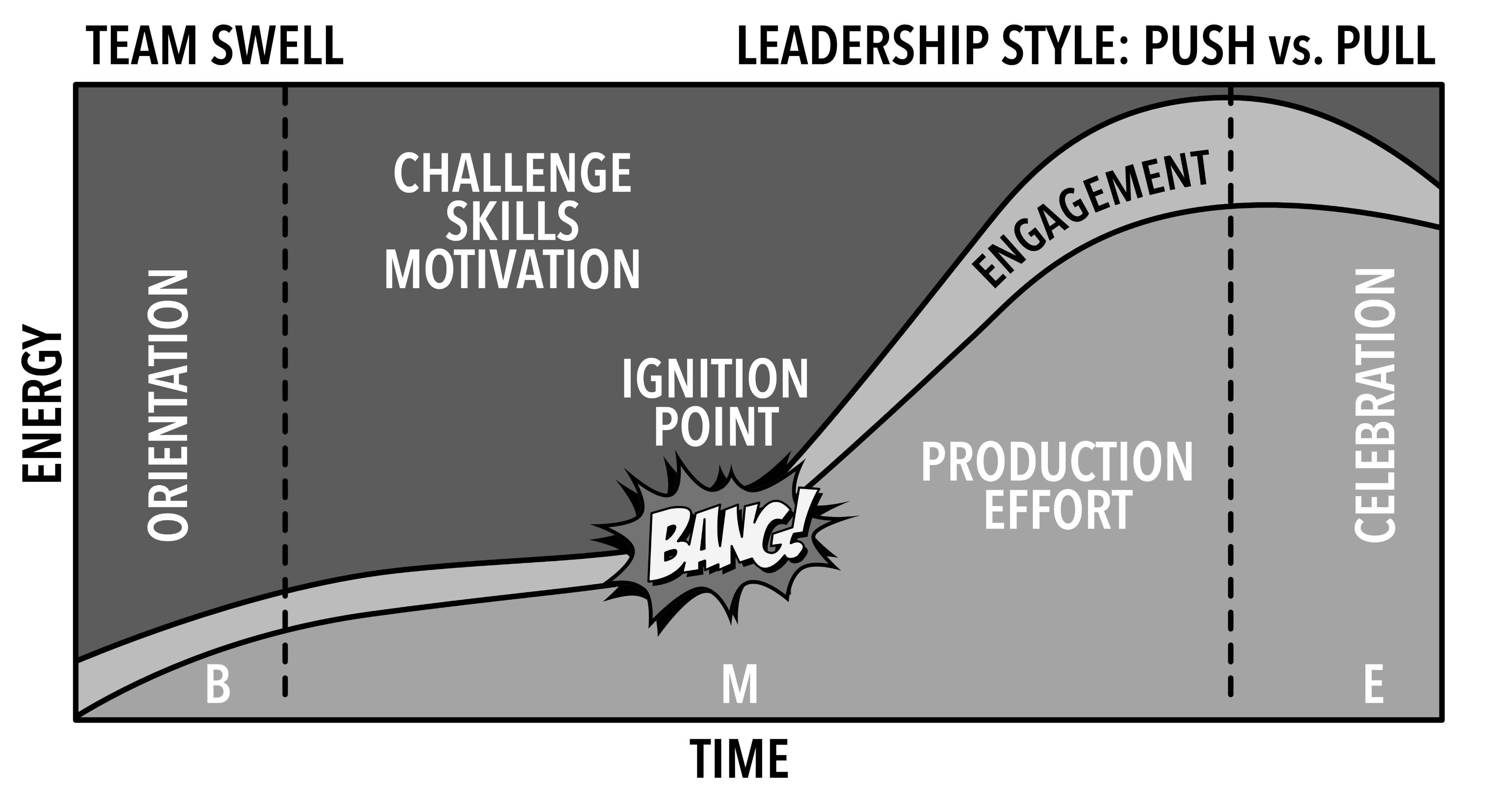
Section 2: The BME Lifecycle (Beginning, Middle, and End)
Every team project has a beginning, middle, and end phase (BME). Long-term operations should have micro-BME cycles built throughout their lifespan (quarterly, annually, etc.).
1. Beginning (The Orientation Stage)
The Profile: In this stage, production output is very low—it is strictly the planning and organizing phase. Done correctly, this is where the engagement foundation is laid.
Core Leadership Actions:
🔥Get to know basic information (names, roles, specific skills, and strengths).
🔥Establish the purpose of the team, how work will be measured, and share the overarching strategy.
🔥Set the clear timeline and expectations for the team's time together.
🔥Audit the resources and context in relation to what people need to get the job done.
2. Middle (The Active Work Phase)
The Profile: This is the reason the team exists. Through appropriate injections of challenge, skill allocation, and motivation tools, engagement elevates and production amplifies.
The Three Drivers of the Middle Phase:
🔥 Ignition: The tipping point when it all comes together, and output dramatically trends upward.
🔥 Production: The measurable work your team is tasked to complete because they are properly skilled and highly motivated.
🔥 Engagement: The experiential feeling of the team functioning together, sharing energy, and taking immense pride in the work done.
3. End (The Celebration Phase)
The Profile: The most critical, yet frequently overlooked stage. This provides the psychological closure that human beings crave.
Core Leadership Actions:
🔥 Recognize achievements and efforts with a logical "close" or "exit" from the project phase.
🔥 Leverage organizational success as a springboard into the "next phase" or future onboarding.
🔥 Create a touchstone of positive memories and feelings to ensure long-term talent retention.
Section 3: Push vs. Pull Leadership Tactics
Depending on the developmental stage of your team within the BME lifecycle, a savvy manager must purposefully utilize either a Push or Pull leadership strategy to get the best out of their people.
The Push Strategy (Task-Centred Approach)
Behavioural Profile: Exerting clear direction using strong motivational tactics, heightened challenges, and specific instructions to elicit a sense of urgency.
Strategic Timing: Critical to use at the Beginning of the team's time together, or during times of project crisis.
The Pull Strategy (Goal-Centred Approach)
Behavioural Profile: Sharing the locus of control with a positively functioning team. Involves inquiry, guided facilitation, and leading from an agreed-upon approach.
Strategic Timing: Highly effective in the Middle stages to encourage autonomy and a team-centred approach to decision making and effort.
Section 4: The Engines of Engagement — Time and Energy
The two most critical variables of team engagement are Time and Energy. Too often, leaders discount the function of time and its direct correlation to team energy.
Time (The Forgotten Key)
Time enables authentic engagement. If a project drags too long, the team loses focus; if the timeline is too short, the team fractures under stress. An engaged team thrives on a timeline built for connection, collaboration, eustress (positive challenge), celebration, and visioning.
Energy (The Leadership Maestro)
A great manager serves as the maestro of their team’s energy. By carefully calculating when to add tasks, when to inject challenges, and when to apply motivation, the leader inspires the team to generate and share their own energy. As collective energy increases, production and engagement universally amplify.
Written by Tyler Hayden | [email protected]. Repurposing info requires review; must attribute and backlink to tylerhayden.com and teambuildingschool.com.
What we do.
We connect 100,000+ qualified prospects looking for financial advice, lending, protection, debt help and claims to advisors and brokers every year.
We will always provide the best service.
We don't launch rockets. We just generate leads from Google, Bing and YouTube, connecting them with your team in real time. And you know what, we're bloody good at it.
Get leads from our existing matured campaigns.
Let us build bespoke lead-gen campaigns in your brand.
Deploy our AI sales androids to boost contact rate.
Utilise our proven systems and technology to increase your return on ad spend.

What We Do
Your proven customer acquisition system that increases conversion rates at every step of the customer journey so you can enjoy record breaking sales.
Effective Lead Generation
Strategically focused on high-intent leads generation tactics from Google, Bing, & YouTube.
Database Reactivation
Turn your old data into fresh appointments and sales, utilising our sales android that never rests.
Appointment Setting
Transform your contact rate and campaign profitability with our appointment setting sales android.
Blog
Your proven customer acquisition system that increases conversion rates at every step of the customer journey so you can enjoy record breaking sales.
Team Building Is Story Building: What a Harvard “Time Travel” Study Teaches Managers About Culture
Team Building Is Story Building: What a Harvard “Time Travel” Study Teaches Managers About Culture
In the early 1980s, Harvard psychologist Ellen Langer ran an experiment that sounds like a thought experiment but behaved like a blueprint. Two groups of men in their seventies and eighties were brought to a retreat space staged as if it were 1959 - mid-century magazines, a vintage radio, black-and-white TV, and conversations anchored in 1959 news and sports. One group was asked to reminisce about 1959 from the present. The other group was asked to do something far more radical: act as if it actually was 1959—to inhabit that identity in real time.
After just one week, both groups improved across a range of physical and cognitive measures. But the men who lived inside the 1959 frame improved more. The implication wasn’t mystical. It was practical: when people inhabit a coherent reality - through cues, expectations, and behaviour -their capabilities can shift. Langer later called this the “psychology of possibility.” The environment and the story didn’t just change how the men thought; it changed what they did, and what became available to them.
That’s not only a health story. It’s a workplace culture story.
Culture isn’t what you say—it’s what your team can prove together
Most managers are trying to build culture with language alone: values statements, posters, onboarding decks, and the occasional speech about “trust” or “ownership.” But teams don’t bond because they heard the right words. Teams bond when they experience something together and can point to it later.
This is the hidden reason we do icebreakers, initiative tasks, and team-building activities. Not for entertainment. Not to “warm up the room.” We do them because they generate evidence—and evidence becomes story.
And story is how teams remember who they are.
When a team completes an initiative task - navigates uncertainty, solves a problem, argues respectfully, makes room for quiet voices, adapts to a surprise constraint—something important happens: the team briefly enters the state it wants more of. Trust becomes real-time behavior, not a concept. Communication becomes observable, not aspirational. Leadership becomes shared, not positional.
But here’s the crucial step most managers miss: if you don’t verbalize what happened, the story evaporates.
Initiative tasks create moments. Debrief creates meaning. Story creates culture.
A team-building activity without reflection is a fun event. A team-building activity with reflection becomes culture construction.
In Langer’s study, the “act as if” group didn’t just talk about being younger; they behaved inside a younger identity. Your team-building moments do the same thing at work: they let people behave inside the future team—if only for five minutes.
The manager’s job is to capture that moment in words:
“Did you notice how quickly we shared information once we named the constraint?”
“When we got stuck, we didn’t blame. We experimented.”
“We trusted the handoff instead of micromanaging it.”
“We stayed curious under pressure.”
That short naming process does something powerful. It acknowledges that a positive state existed here, with these people, in this team. Once spoken, it becomes part of the team’s identity: we can do this. And once a team believes “we can do this,” it stops being limited to the activity. It becomes portable.
Now that state is applicable to the rest of the team’s lived realities: project planning, conflict conversations, stakeholder meetings, deadlines, and change fatigue.
Managers: stop asking for the culture you want. Start staging it.
The Harvard study wasn’t just mindset - it was environment design. The retreat was full of cues that made 1959 believable. That’s your leadership challenge: build the conditions where the team you want can show up.
If you want a culture of ownership, design moments where ownership is required and safe.
If you want psychological safety, design moments where small risks are rewarded.
If you want collaboration, design moments where lone-wolf behavior can’t win.
Then, when the team succeeds - even in small ways—tell the story back to them.
Make stories reusable: bring them into meetings where it matters
A story becomes culture when it gets reused at the point of need.
When the real work gets tense, a manager can say:
“This feels like that initiative task where we had too many options. What did we do that worked?”
“Remember when we had no clear leader and we still got it done? Let’s do that again.”
“We’ve already proven we can communicate under pressure. Use the same pattern.”
That’s when team building stops being an event and becomes an operating system.
The question every manager should ask weekly
Not “Did we do team building?”
But:
“What story of success did we create this week—and did we name it out loud?”
Because once you start collecting those stories, you’re not just managing tasks. You’re building an identity. And like the men in that Harvard retreat, once people start living inside a better story, they begin to behave as if it’s true—until, eventually, it is.


Check Tyler's Availability for Your Next Event
Grab a time to connect or shoot us an email.
Follow Us & Join the Conversation


Locations Served
Shop, Learn, and Explore
Speaker Topics
Location and Contact
(902) 541-0858
23 Horizon Road
Bedford, Nova Scotia B4A 3N2
Canada
© 2026 Tyler Hayden Inc. All rights reserved.