
The Team Swell Methodology: Structuring the Lifecycle of High-Performing Team Framework
Formulated by Hall of Fame speaker Tyler Hayden, "The Team Swell" is an operational blueprint mapping the exact behavioral science of a high-functioning team hitting its absolute peak. From the moment your team walks through the door to the final project debrief, The Team Swell methodology decodes the specific leadership interventions required across a project’s lifecycle to sustain long-term engagement.
Core Deliverables: 1. The BME Lifecycle Framework 2. Push vs. Pull Leadership Matrix 3. Time & Energy Optimization Strategies.
Section 1: The Core Philosophy — What is The Team Swell?
Axiom: "A great team doesn't just happen; it is actively engineered through a beginning, middle, and an end."
Think back to a time when you had a high-functioning team that really knocked a project or venture out of the park. That momentum isn't accidental. It requires a leader who understands how to invest and plan for specific developmental stages.
The Team Swell methodology matters specifically for managers who want to:
🔥 Increase strategic engagement over long-term projects.
🔥Explore planning for sustained team production.
🔥Invest in levelling-up their dynamic leadership skills.
🔥Focus on building a deeply connected, strong team culture.
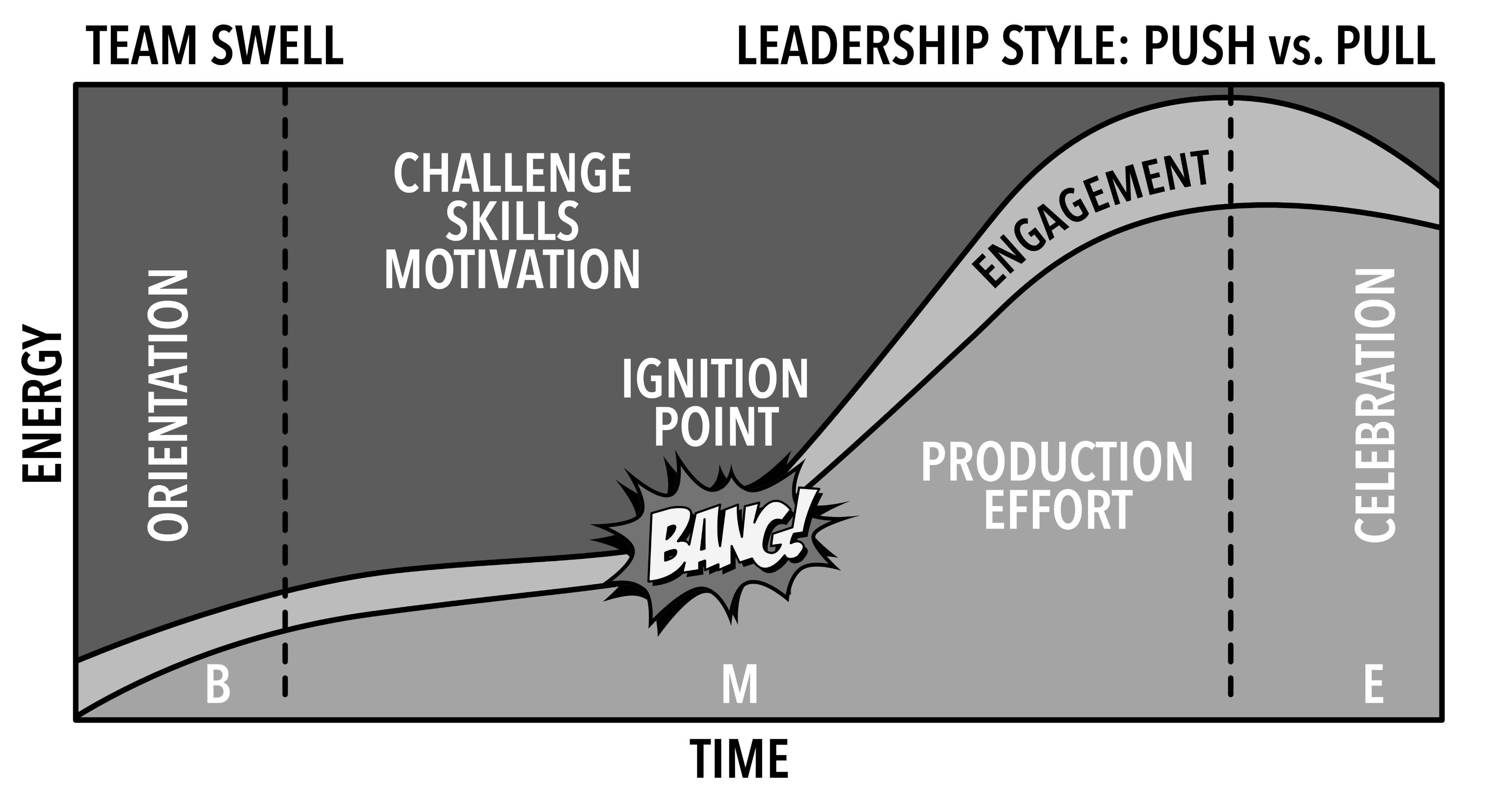
Section 2: The BME Lifecycle (Beginning, Middle, and End)
Every team project has a beginning, middle, and end phase (BME). Long-term operations should have micro-BME cycles built throughout their lifespan (quarterly, annually, etc.).
1. Beginning (The Orientation Stage)
The Profile: In this stage, production output is very low—it is strictly the planning and organizing phase. Done correctly, this is where the engagement foundation is laid.
Core Leadership Actions:
🔥Get to know basic information (names, roles, specific skills, and strengths).
🔥Establish the purpose of the team, how work will be measured, and share the overarching strategy.
🔥Set the clear timeline and expectations for the team's time together.
🔥Audit the resources and context in relation to what people need to get the job done.
2. Middle (The Active Work Phase)
The Profile: This is the reason the team exists. Through appropriate injections of challenge, skill allocation, and motivation tools, engagement elevates and production amplifies.
The Three Drivers of the Middle Phase:
🔥 Ignition: The tipping point when it all comes together, and output dramatically trends upward.
🔥 Production: The measurable work your team is tasked to complete because they are properly skilled and highly motivated.
🔥 Engagement: The experiential feeling of the team functioning together, sharing energy, and taking immense pride in the work done.
3. End (The Celebration Phase)
The Profile: The most critical, yet frequently overlooked stage. This provides the psychological closure that human beings crave.
Core Leadership Actions:
🔥 Recognize achievements and efforts with a logical "close" or "exit" from the project phase.
🔥 Leverage organizational success as a springboard into the "next phase" or future onboarding.
🔥 Create a touchstone of positive memories and feelings to ensure long-term talent retention.
Section 3: Push vs. Pull Leadership Tactics
Depending on the developmental stage of your team within the BME lifecycle, a savvy manager must purposefully utilize either a Push or Pull leadership strategy to get the best out of their people.
The Push Strategy (Task-Centred Approach)
Behavioural Profile: Exerting clear direction using strong motivational tactics, heightened challenges, and specific instructions to elicit a sense of urgency.
Strategic Timing: Critical to use at the Beginning of the team's time together, or during times of project crisis.
The Pull Strategy (Goal-Centred Approach)
Behavioural Profile: Sharing the locus of control with a positively functioning team. Involves inquiry, guided facilitation, and leading from an agreed-upon approach.
Strategic Timing: Highly effective in the Middle stages to encourage autonomy and a team-centred approach to decision making and effort.
Section 4: The Engines of Engagement — Time and Energy
The two most critical variables of team engagement are Time and Energy. Too often, leaders discount the function of time and its direct correlation to team energy.
Time (The Forgotten Key)
Time enables authentic engagement. If a project drags too long, the team loses focus; if the timeline is too short, the team fractures under stress. An engaged team thrives on a timeline built for connection, collaboration, eustress (positive challenge), celebration, and visioning.
Energy (The Leadership Maestro)
A great manager serves as the maestro of their team’s energy. By carefully calculating when to add tasks, when to inject challenges, and when to apply motivation, the leader inspires the team to generate and share their own energy. As collective energy increases, production and engagement universally amplify.
Written by Tyler Hayden | [email protected]. Repurposing info requires review; must attribute and backlink to tylerhayden.com and teambuildingschool.com.
What we do.
We connect 100,000+ qualified prospects looking for financial advice, lending, protection, debt help and claims to advisors and brokers every year.
We will always provide the best service.
We don't launch rockets. We just generate leads from Google, Bing and YouTube, connecting them with your team in real time. And you know what, we're bloody good at it.
Get leads from our existing matured campaigns.
Let us build bespoke lead-gen campaigns in your brand.
Deploy our AI sales androids to boost contact rate.
Utilise our proven systems and technology to increase your return on ad spend.

What We Do
Your proven customer acquisition system that increases conversion rates at every step of the customer journey so you can enjoy record breaking sales.
Effective Lead Generation
Strategically focused on high-intent leads generation tactics from Google, Bing, & YouTube.
Database Reactivation
Turn your old data into fresh appointments and sales, utilising our sales android that never rests.
Appointment Setting
Transform your contact rate and campaign profitability with our appointment setting sales android.
Blog
Your proven customer acquisition system that increases conversion rates at every step of the customer journey so you can enjoy record breaking sales.
The Best Team Building Activities for Remote Teams (From Someone Who's Actually Done It)
By Tyler Hayden CSP, HoF — Hall of Fame Motivational Speaker & Team Building Expert
Let me be straight with you: most blog posts about remote team building are written by people who Googled "fun Zoom activities" and repackaged the results.
This one isn't that.
What follows is 30 years of hard-won experience — from running team building for the PGA Tour, healthcare systems, financial institutions, and remote-first startups — distilled into a practical guide for managers who want their virtual meetings toactually do something.
Let's go.
First, Stop Picking Activities at Random
Before I recommend a single activity, I ask one question:Who's in the room?
Not their job titles. Not how many people are on the call. I mean:how do they learn?
Every recommendation I make starts with MIQ — Multiple Intelligence Quotient. It's the lens I use to understand a team's learning preferences before I design anything. Are they kinesthetic learners who need todosomething? Mathematical-logical types who love structure and metrics? Interpersonal learners who just want to connect?
Get that wrong, and the best activity in the world will still land like a wet towel.
Real example:I was brought in to work with the PGA. My initial instinct was to lean heavily into interpersonal learning — lots of discussion, sharing, connection. These were leaders and managers, after all.
Then I looked closer. The majority of people in the room were golf pros. Kinesthetic learners through and through. They learn with their hands, through movement, throughdoing.
So we scrapped the talk-heavy approach and rebuilt the program around hands-on, activity-based experiences. The result? Full engagement. And it combined both kinestheticandinterpersonal in a way that served everyone.
The lesson: don't assume. Diagnose first.
The #1 Mistake Managers Make with Remote Team Building
You heard about a team building activity thatcrushed itfor another manager. You think: perfect, I'll run that.
Stop right there.
What works for their team may completely flop with yours.Not because the activity is bad — but because it wasn't designed foryourpeople.
My Team Learning Model says that for any activity to stick, it has to haveunique, relative contextto the work your team actually does. It can't be fluffy. It can't feel disconnected. There has to be a logical, natural bridge between the activity and what your team does Monday through Friday.
That means if your team works in sales, the activity should connect to how they communicate, how they handle objections, how they support each other in the process. If they're in healthcare, it connects to how they engage under pressure, how they support colleagues, how they decompress.
This is why I builtRubber Chicken AI— to help managers identify therightactivity for their specific team makeup and learning outcomes, without having to start from scratch every time.
What Most Facilitators Get Wrong (The Dreaded Icebreaker)
Everyone knows the feeling. The manager launches a "fun" icebreaker on Zoom. It's awkward. It runs way too long. The energy in the room slowly deflates like a balloon three days after a birthday party.
Here's the problem:they let it go too long.
The best team building activities — especially icebreakers — should end at theirhigh point. Not when the rules say it's done. Not when everyone has had a turn. At the peak of energy, excitement, and engagement.
End it while people are still leaning in. Leave them wanting more.
That principle alone will change how your virtual meetings feel.
The Waterfall Technique (Try This This Week)
One of the most consistently effective activities I run remotely is something I callCoffee Talk— an open-ended statement or question that the whole team answers.
Here's hownotto run it: ask the question, then go around the room one by one. What happens? Some people give one-word answers. Others ramble for three minutes. The energy yo-yos. You lose control.
Here's theWaterfall Technique:
Pose the open-ended question or prompt
Ask everyone to type their answer into the chat — butdon't hit send yet
Count down: 3… 2… 1…send
Everyone's answers populate at the same time — cascading down the screen like a waterfall. The whole room gets to read them all, simultaneously, in real time.
It's fast. It's visual. It's surprisingly exciting. And it gives every single person a voice without anyone dominating the conversation or tanking the energy.
The reason open verbal participation fails isn't because people don't have good things to say — it's becauseyou can't always control how engaging those answers are going to be. The Waterfall Technique solves that.
How to Scale Remote Team Building: Small vs. Large Teams
Here's where most one-size-fits-all guides fall apart. A 10-person startup and a 500-person enterprise need completely different approaches.
For Small Teams (10–50 people):
Run it live. Everyone on screen at the same time. Keep it synchronous so the energy builds collectively. You can track metrics in real time, respond on the fly, and create genuine shared moments.
For Large Organizations (100–500+ people):
Thinkasynchronous + aggregate.
Run the same activity in multiple smaller groups at different times — maybe across different time zones or departments. Set up aleaderboardthat accumulates results from all groups over time. People may not all be in the same session, but they're connected through the shared challenge and the growing scoreboard.
The competitive element keeps people engaged even when they're not together. And the final reveal — seeing how the whole organization performed — creates a collective moment that lands even if it's delivered asynchronously.
Competition: Friend or Foe?
Some facilitators avoid competition entirely. I understand the instinct — you don't want anyone left behind or demoralized.
But here's the nuanced truth:the problem isn't competition. It's not understanding your audience.
Through the MIQ lens:
Mathematical-logical learnerslove leaderboards. They want to know who's first, second, and third. Competitionenergizesthem.
Naturalistic learnerslike to categorize and compare. They engage with structured wins.
Interpersonal learnerscare less about winning and more about whether everyone is included. You can still use competition — just make sure no one gets left out.
Intrapersonal learnerscan get stressed by competitive pressure. They want clarity and intention behind the metrics.
The question isn't "should I use competition?" The question is"how do I deliver competition in a way that aligns with how my specific team sees winning?"
Get MIQ right, and competition becomes a tool. Get it wrong, and it becomes a liability.
Team Building Is Not a One-Time Event
This might be the most important thing in this entire post.
Team building is what you dowithpeople — nottopeople.
It's cumulative. It's built incrementally over time. A 60-minute Zoom activity is a capstone, not a solution.
The real magic happens in thefive-minute wins— the quick, intentional moments woven into your regular meetings and routines that reinforce the same message, over and over, until it becomes culture.
Think of it like fitness. One epic workout doesn't make you fit. Showing up consistently does.
One team building event won't transform your team. Astrategyof small, well-placed, work-relevant activities — week over week — will.
The Icebreaker Is a Door, Not a Destination
Here's the final reframe I want to leave you with.
The icebreaker isn't the point of your meeting. It's theopening act.
A great remote team building activity — whether it's Coffee Talk, a competitive challenge, or a collaborative exercise — should function as aspringboardinto the rest of your agenda. It warms up the room. It sets the tone. It signals:this is a space where we're engaged, present, and working together.
When you design it that way — when the activity ties naturally into the conversation you're about to have, the skills you're about to practice, or the culture you're trying to build — that's when it stops feeling like an obligation and starts feeling like the best part of the meeting.
Your Action Items for Monday Morning
Before your next activity:Ask yourself what you know about your team's learning preferences. If you don't know — find out.
Try the Waterfall Techniquein your next team meeting. One question. Countdown. Watch what happens.
Set a high-point exit.End your next icebreakerearly— while energy is still high.
Connect the activity to the work.Every single time. No fluffy standalone events.
Think long-term.What's your team building strategy for the next 90 days — not just the next meeting?
Fun is the delivery. Better teams and energy on Monday is the point.
If you want to know what activities are right foryour specific team, tryRubber Chicken www.rubberchicken.ai — it's built to help managers find the right fit based on real team makeup and real learning outcomes.
Or, if you want to bring a fully customized remote team building experience to your organization,book a discovery calland let's figure out exactly what your team needs.
Tyler Hayden CSP, HoF is Canada's Hall of Fame Motivational Speaker and the founder of Team Building School and Rubber Chicken AI. He has delivered team building experiences to audiences of 8 to 8,000 across Canada and beyond.


Check Tyler's Availability for Your Next Event
Grab a time to connect or shoot us an email.
Follow Us & Join the Conversation


Locations Served
Shop, Learn, and Explore
Speaker Topics
Location and Contact
(902) 541-0858
23 Horizon Road
Bedford, Nova Scotia B4A 3N2
Canada
© 2026 Tyler Hayden Inc. All rights reserved.